 Rajiv Gangwar · 4 min read
Updated
Separate student visa evidence from university admission records and document authentication, including why India-specific legalization advice matters.
A student may receive document instructions from a university, a visa application centre and an authentication office. Those requests can overlap, but they are not interchangeable. Before paying for a translation or sending an original certificate, identify who needs it and for what purpose.
This guide separates those document decisions. For choosing the study category and understanding the application sequence, start with the China student visa guide.
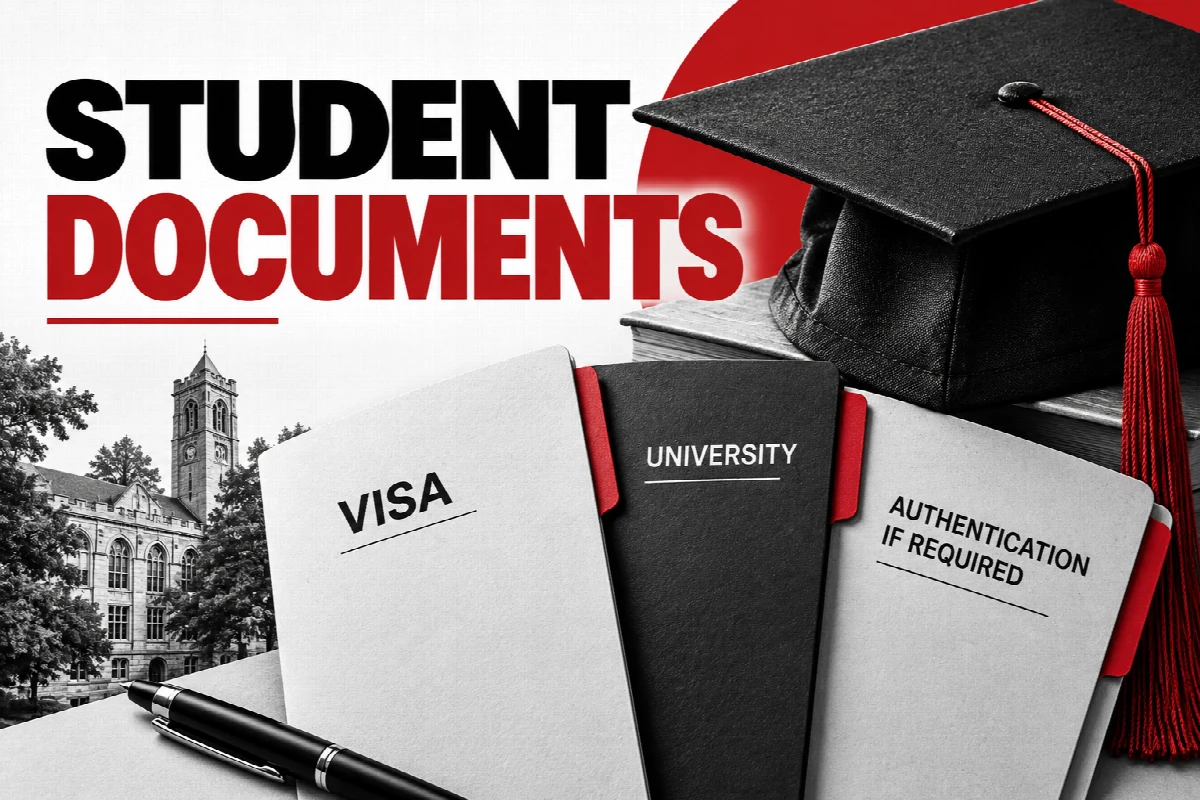
Put each request in the right column
| Document task | Who defines the requirement? | Question to resolve |
|---|---|---|
| Visa application evidence | The applicable Chinese authorities and handling visa centre | Which study-category documents and formats does this application need? |
| Admission or enrolment records | The receiving institution | Is the document for admission, registration, scholarship review or another university purpose? |
| Authentication, where applicable | The receiving authority and relevant authentication authorities | Which particular document needs authentication, through which route, and for what use? |
Keep the original request or email in each folder. A university's acceptance of a scan does not establish the visa centre's physical-document requirements. Likewise, a document prepared for an admission assessment should not be described as a universal visa requirement.
Read the study-category checklist carefully
The Kolkata X1 checklist lists admission material and JW201/JW202 with original-and-copy wording. The New Delhi X2 category page lists admission material and a covering letter, with different study-form detail. These are centre-specific references, not one interchangeable national checklist.
There is also differing study-form wording in broader Delhi guidance. If your category page, online request and university instructions appear inconsistent, send the precise question to the handling centre and institution. Do not infer that every X2 applicant needs an identical form, or that an omission on one page cancels a case-specific request.
When the institution issues a replacement document, compare the applicant name, passport details where shown, programme and study dates. Keep the final version identifiable so that a superseded admission letter is not uploaded by mistake.
When separate authentication may matter
An institution or receiving authority may ask for an academic or personal document in an authenticated form. First obtain the requirement for that particular document. Ask whether the request concerns the original, a copy, a translation or a combination; who must issue or certify it; and when it must be presented. These are questions to resolve, not a claim that every student must complete every step.
The New Delhi legalization guidance describes a separate document-authentication process. Its existence does not make legalization a standard condition for every student visa file.
Do not assume an apostille-only route for Indian documents
China's accession to the Apostille Convention does not, by itself, settle the route for a document issued in India. The HCCH treaty notification record records India's objection to China's accession. Generic advice written for another country can therefore mislead an Indian applicant.
Verify the current India-to-China route with the receiving authority and relevant authentication authorities before starting. Give them the document type, issuing country and intended use. Do not assume either that an apostille alone is sufficient or that every academic record needs consular legalization.
Resolve the request before dispatching originals
Make a short record of the requester, exact document, required format, deadline and confirmed route. If the answer remains unclear, ask a focused written question rather than buying a package of unnecessary attestations. The document checklist helps separate common and category evidence. The national attestation service is relevant only once a separate authentication need has been established.
Official information checked
If the institution has requested authentication, the broader Indian-document authentication route guide helps separate the receiver's request, treaty position and current legalization instructions.
Official sources checked on 23 September 2026. Study forms, centre instructions and authentication arrangements are freshness-sensitive and should be checked again for the actual submission.